- Télécharger l'application
-
Opportunités de volontariat
Destinations populaires
Voir toutes les opportunités de volontariatQuel type d'expérience recherchez-vous ?
- Academy
- Blog communautaire
- WP Life
- Réductions exclusives
- Comment ça marche
- Aide
- Se déconnecter
- Se connecter
- S'inscrire
- Devenir Hôte
- Français

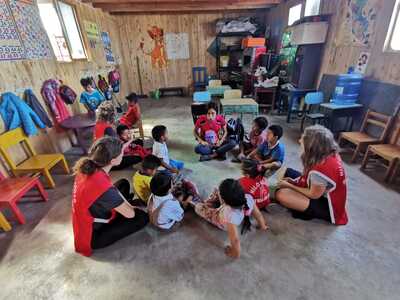
Teaching and helping out at the project
L'expérience
There are 3 classes: 3-year-olds, 4-5-year-olds, and 6 years and above. You can choose where to help. You don’t need to be a professional teacher, just have lots of love for the kids—they will return it. Basic Spanish is needed for communication, but fluency isn't required. You won’t be left alone with a whole class, but it's helpful if you can take the initiative with your teaching ideas. The focus will be on reading, writing, math, and English.
Ce que vous offrez
20 heures d'aide par semaine
Musique: Jouer pour divertir les invités, les enfants ou les communautés locales.
Garde d'enfants: S'occuper des enfants, jouer avec eux et passer du temps ensemble.
Travail social: Aider au travail bénévole dans des projets locaux et des communautés.
Enseignement des langues: Enseigner une langue à l'hôte, aux invités ou aux communautés locales.
Frais supplémentaires requis
Montant: € 8 Par jour
Les frais couvrent: Avantages pour les voyageurs, Matériel pour les activités de volontariat, et Don au projet
Description: Este dinero te da derecho a alojamiento (de lunes a domingo) y tres comidas al día (de lunes a viernes): desayuno, almuerzo y cena. Sin embargo, la mayor parte de tu contribución va directamente al proyecto; este es el propósito principal de la contribución. Sin ella, la asociación tendría dificultades para sobrevivir.
Ce que vous recevez
2 jours de congé par semaine
Chambre privée: Vous aurez un lit dans une chambre privée. En d'autres termes, une chambre rien que pour vous.
Dortoir partagé: Vous aurez un lit dans une chambre partagée, ce qui signifie que vous partagerez la même chambre avec d'autres voyageurs.
Dortoir de l'équipe: Vous aurez un lit dans une chambre partagée, ce qui signifie que vous partagerez la même chambre avec d'autres personnes.
Petit-déjeuner: Vous avez droit à un petit-déjeuner gratuit, tous les jours de votre séjour.
Déjeuner: Vous avez droit à un déjeuner gratuit, tous les jours de votre séjour.
Dîner: Vous avez droit à un dîner gratuit, tous les jours de votre séjour.
Utilisez notre cuisine équipée: N'hésitez pas à utiliser notre cuisine et préparer vos propres délicieux repas.
Certificat: Obtenez un certificat d'achèvement après avoir terminé votre expérience.
Accès Internet Basique: Internet à vitesse basique pour travailler à distance
Exigences
Plus de 18 ans
Accueille les volontaires solo, les couples et les partenaires de volontaires
Être originaire d'un pays autre que Pérou
Ce qui n'est pas inclus
Vols, assurance voyage, transport interne et visa
Détails du programme
Our school is located in the city of Trujillo, in the district of La Esperanza. This is one of the largest districts of the city, and also one of the poorest. For this reason, we have chosen to develop our project here.
Our goal is to create a place where the affected children (3 to 15 years old) and families can feel safe and comfortable while learning and/or reinforcing both their academic and social abilities. In this way we try to abolish the rate of illiteracy and the social inequality gap.
The school is implementing aid programs in the areas of education, child labor, health, nutrition and family planning. We work with the most vulnerable groups regardless of race, religion or social status.
Activités et horaires
The schedule at the school is:
Mornings: Monday to Friday from 8:00 AM to 12:30 PM. We have a recess of approximately 30 minutes from 10:15 to 10:45.
Afternoons:
Twice a week, we visit families from 3:00 PM to 5:00 PM.
Preparation of activities.
The teacher is in charge of the development of the classes in the educational project, being responsible for the activities and guidance.
The Red Thread volunteer in the neighborhood will be identified by the residents by their red vest, which they must wear as a distinctive mark of their community help.
Additionally, you will have the opportunity to get to know our project in depth through visits to the families, but first, we want you to get to know the children well so that you can better understand the reasons for certain behaviors or attitudes once you visit.
What are the days like?
Once a week, the volunteers meet to organize the week